PCD Pharma vs Ethical Pharma vs Generic — Key Differences Explained
- WHO-GMP Certified
- Monopoly Rights
- 500+ Products
- Fast Dispatch
When you research the pharma business in India, you quickly encounter three terms: PCD pharma, ethical pharma, and generic medicine. Each represents a different way of marketing and distributing medicines. If you are planning to start a pharma franchise, understanding these differences helps you make the right business decision.
Fuel Biotech, a leading PCD pharma franchise company, explains all three models clearly so you can choose the one that fits your goals, investment capacity, and market.
What Is Ethical Pharma?
Ethical pharma refers to the model where a pharmaceutical company employs its own medical representatives (MRs) to promote branded products directly to doctors. The company sets strict sales targets, provides company-owned promotional materials, and pays the MR a fixed salary plus incentives.
In the ethical model, the brand belongs entirely to the company. The MR acts as an employee, not as an independent business owner. The company retains full control over marketing, pricing, and territory.
- The MR earns a salary — not a margin on sales
- The company owns all relationships and territories
- Targets are mandatory — non-performance leads to consequences
- The investment risk falls entirely on the company
What Is Generic Medicine?
Generic medicine refers to drugs sold by their chemical or salt name rather than a brand name. A generic amoxicillin tablet contains the same active ingredient as a branded amoxicillin — but sells at a significantly lower price because there is no brand-building cost involved.
Generic medicine distributors focus on supplying government hospitals, Jan Aushadhi stores, and low-cost pharmacy chains. Margins are thin but volumes are high. The generic model requires strong logistics and a large stockist network.
- Products sell under salt names, not brand names
- Margins are lower but volumes can be very high
- Doctor prescription pull is minimal — price is the driver
- Suitable for bulk supply to institutions rather than individual doctor detailing
What Is PCD Pharma?
PCD stands for Propaganda Cum Distribution. In the PCD model, a pharma company like Fuel Biotech grants an independent individual or firm the right to market its branded products in a specific territory. The franchisee is not an employee — they are an independent business owner who earns margins on every sale.
The PCD model combines the brand strength of ethical pharma with the entrepreneurial freedom of running your own business. You build your own doctor network, set your own work schedule, and grow at your own pace — all while selling established, quality-certified products.
- Products carry Fuel Biotech’s brand name
- You own your territory with monopoly rights
- You earn margins — not a salary
- No mandatory sales targets
- Low investment to start, high scalability
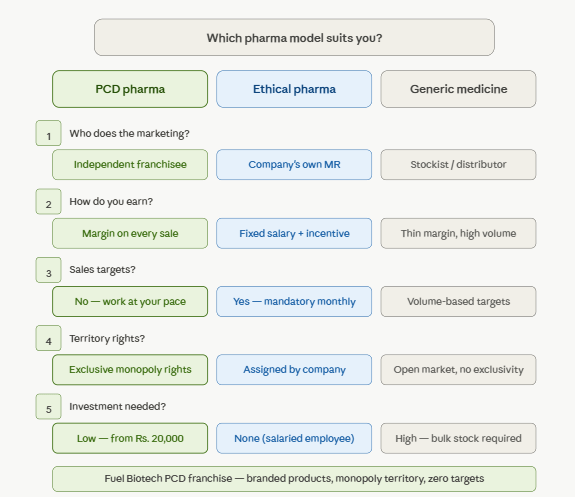
Side-by-Side Comparison
Feature | PCD Pharma | Ethical Pharma | Generic |
Who markets? | Independent franchisee | Company’s own MR | Stockist / distributor |
Brand ownership | Company (Fuel Biotech) | Company | None (salt name) |
Income type | Margin on sales | Salary + incentive | Margin (thin) |
Sales targets | No | Yes (mandatory) | Volume-based |
Territory | Monopoly rights | Assigned by company | Open/competitive |
Investment | Low (₹20K–₹2L) | None (employed) | High (stock) |
Risk | Low | Low (employee) | Moderate to high |
Doctor detailing? | Yes, by franchisee | Yes, by company MR | Minimal |
Which Model Suits You Best?
Choose PCD pharma if you want:
- An independent business with low startup investment
- Exclusive territory without internal competition
- Freedom to work without targets or bosses
- Branded products with built-in quality assurance
- The ability to scale by adding more divisions over time
Choose ethical pharma if you want:
- A stable salaried job in the pharma industry
- Company-backed training and career growth
- No personal financial risk or business management responsibility
Choose generic medicine distribution if you want:
- High-volume supply to government institutions or low-cost stores
- A business driven by price rather than brand
- Thin margins balanced by bulk quantities
Why Most New Pharma Entrepreneurs Choose PCD
The PCD model offers the best of both worlds — the credibility of a branded company like Fuel Biotech and the freedom of entrepreneurship. You do not carry the risk of manufacturing. You do not face the pressure of an employment contract. You build real business equity in your territory over time.
As your doctor base grows and prescription volumes increase, your income grows proportionally. Many Fuel Biotech franchise partners start with one or two divisions and expand to five or six within two to three years, significantly multiplying their monthly earnings.
Fuel Biotech: The Right PCD Partner for Your Pharma Business
Fuel Biotech offers a transparent, franchisee-friendly PCD model with WHO-GMP certified products, strong promotional support, and clear pricing across all therapeutic divisions. Whether you are new to pharma or already working as an MR and considering independence, Fuel Biotech gives you everything you need to start and grow.
Explore how the PCD model works in detail in our complete guide: How Does PCD Pharma Franchise Work? Or if you are ready to understand territories and rights, read our article on monopoly rights in PCD pharma franchise.